e-mail : customdataservicesinfo@gmail.com

Custom real-time data process interfaces. Quickly. |
|
Utilize components of established technologies to design, build, connect, share, and iterate custom process interfaces. Custom process interfaces enable authenticated users to securely search, input, upload, update, calculate, sort, merge, print, send, or run parameterized processes or transactions on individual data sources or combinations of databases and APIs in real-time. |
|
|
Ultra-versatile, fast development, simple management, minimal expense. HTML, PHP, SQL, cURL, and JavaScript are all open-source technologies (so zero cost) while FileMaker (optional) costs roughly $30.00 US a month per user, unlimited interfaces and processes.
Similar-ish in concept to app builders like base44.com, bolt.new, lovable.dev, replit.com, with key differences being your processes remain proprietary, your data stays sovereign, and you own the code, with no security concessions, data leaks, or third-party dependencies. |
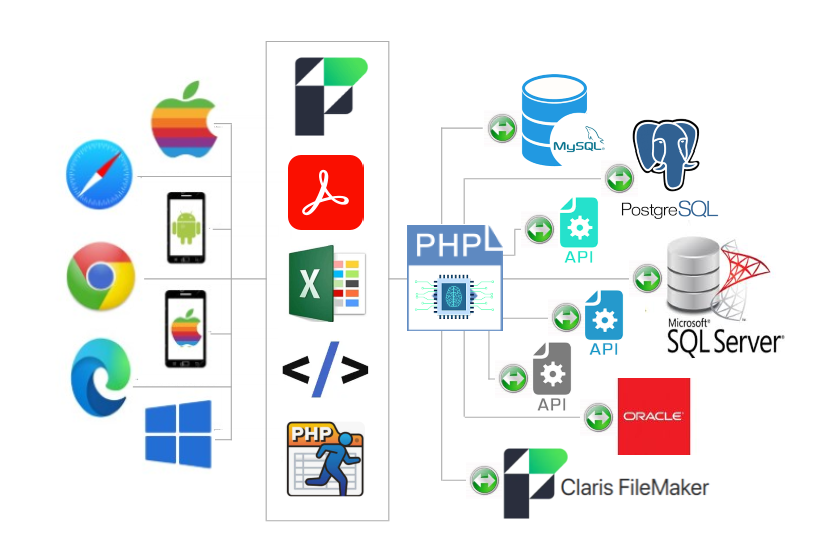

Claris FileMaker is a versatile application and server, integrating best-in-class form builder with relational database engine, advanced calculation editor, scriptable process automation controls, securable authentication and session management. FileMaker database files can be used individually or shared using either the desktop application or WebDirect forms, and can be extended to enable real-time interactions with SQL databases or APIs.

Adobe Acrobat PDF forms can be used as programmable data interaction runtimes. Documents converted to PDF forms can post query parameters to PHP scripts that interact with databases or APIs and return filtered results to designated form fields in real-time. Acrobat PDF forms are far more securable than HTML forms because they are not susceptible to XSS, CSRF, or session attacks and can be password protected, encrypted, flattened, and digitally signed.

Microsoft Excel spreadsheets can use calculations to format and package and the WEBSERVICE() function to send user-supplied parameters to PHP scripts that execute queries on databases or APIs, returning filtered query results to active spreadsheet cells in real-time, updating related calculations during the process. Excel spreadsheets can also be converted into dynamic HTML and JavaScript forms using either AI or SpreadSheetConverter.

HTMX improves efficiency by providing access to AJAX, CSS Transitions, and Server Sent Events directly in HTML. Instead of parsing JSON and updating the DOM with JavaScript, HTMX allows the server to return pre-rendered HTML fragments that are dynamically swapped into the page. Many document types can be converted to HTMX or HTML forms that can be used standalone or shared with authenticated users or groups via PHPRunner interfaces.

PHPRunner, by Xlinesoft, is a desktop application that generates securable web-enabled create, read, update, delete, search, navigate, import, export, upload, download, print and process interfaces for combinations of MySQL, Oracle, SQLite, MariaDB, SQL Server, PostgreSQL, DB2, or Informix databases. PHPRunner-generated interfaces can additionally be configured to securely share HTML or HTMX forms interfaces with authenticated user groups.

PHP is a server scripting language used on approximately 75% of websites globally. PHP Data Objects (PDO) and cURL code libraries provide efficient, securable, injection-resistant methods for performing SQL, API, email, or file system processes.
AI code-generation severely speeds up the development of high-quality PHP code. PHP is open-source, so no licensing costs or subscriptions are required to own and use reliable industrial strength code.
Created to enable a department to track and examine expenses in greater detail than a legacy accounts payable system could easily accommodate. Information from incoming invoices is extracted and classified by departmentally defined project, matter codes, and attributes. A subset of the data is summarized to print payment request forms in the format expected by the legacy system, while additional data is used to create detailed reports and exported for pivot table analysis.
When a corporate e-mail server suffered an unrecoverable failure immediately prior to its scheduled daily backup, a database was quickly built that could parse the server's transmission logs and send each user an individual message listing details of messages lost in the failure. The technology was later used to automate mass transmission of individually tailored messages including encrypted and compressed file attachments.
This system integrated four legacy databases into a single resource, creating a coordinated mechanism for brand protection services while providing a searchable catalog of trademark infringement, opposition, and counterfeit intelligence. Users in North America, Asia, and Europe maintain the database, with related documents and images imported, cataloged, and stored on a secure intranet server and retrieved via standard web browser.
Tracking corporate information for a portfolio of 100+ international companies — including reporting obligations and deadlines, shareholder and board member details, directorships, share distributions, policy statements, by-laws, charters, and minutes — this system was co-developed by administrators on three continents working collaboratively on interface and functionality iterations.
Programmed to query a REST API containing exchange rates for 170 countries, this utility parses rate information and builds a comparison table of each currency's units per base rate and base rate per unit. Updated information is then passed into an accounts payable database for inclusion in currency-related calculations.
This database repackages data extracted from a mainframe directory application to create an MS Exchange server's e-mail distribution list input file. Administrators gain precise control over rules for defining list membership and error detection in e-mail address components. The system also serves as an enhanced corporate directory with hierarchical departmental cross-references and comprehensive records on 14,000+ employees, contractors, and temporary workers.
Utility databases that provide a simple way to incorporate video content into e-commerce product listings. Adapted to existing systems, they make it significantly easier to correctly add, modify, or delete product information in Shopify or WooCommerce catalogs containing unlimited numbers of products.
A department required the ability to process web form submissions without adding database functionality to the web server. A database was built to batch-collect forwarded e-mail messages from the CGI, parse out relevant data, and transfer it into dynamically created records in a multi-user database.
A rules-based database that runs scheduled examinations of server event logs seeking specific administrator-defined error messages. Once a target error is detected it can trigger a variety of actions including running commands, scripts, and batch processes, or sending e-mail alerts, pages, or SMS reports.
When two departments discovered overlapping data collections with no common field to relate them, a database was built that used multiple criteria to compare components in each collection, narrowing potential matches to a pick list. A workgroup was trained to make final selections based on visible record properties, and the two collections were accurately merged in a single afternoon.
After evaluating various commercial electronic forms management applications, a database system was built to transfer paper business forms into electronic format. Form designers can scan paper documents or build layouts from scratch, embedding complex calculations, conditional pop-up choice lists, relational lookup fields, and rich online help. Deployed via FileMaker WebDirect, users fill out forms using a standard web browser with real-time data collection and automated procedures triggered by submitted data.
A busy specialty retail consignment business with hundreds of thousands of consigned items across 16 locations in three states needed a centralized solution to better manage inventory. A database system was created utilizing the company's established business logic, providing a simple forms-based interface for point-of-sale functions and a central administrative interface for generating payment checks.
A fine jewelry appraisal company's growth was being limited by the lack of automated processes for appraisers to describe and accurately price client items. A database was built that translated the company's business logic and methods into forms with multi-parameter lookups and dynamic calculations, generating high-quality appraisals along with optional Report Cards and e-mailable PDFs.
Providing attorneys a simple method to keep accurate tabs on various litigation management components, this system is a searchable catalog of detailed court and counsel information, case analysis, litigation types, case statuses, key dates, parties involved, damages claimed, and depositions scheduled. It also tracks legal fees by vendor, invoice, and date, and provides links to the accounts payable system for drill-down fee detail.
This database references 250,000+ pieces of jacketed microfiche. An error-checking utility was first built to import the catalog data from a legacy mainframe application, then a reference application was built to contain file classifications, data type descriptions, and retention schedules. A purge module and web-enabled search interface for authorized users were also developed.
A searchable database of 200,000+ folders stored in 66,000+ containers, indexed by file classifications, key dates, and user-supplied content descriptions. A web interface enables authorized users to search for and request retrieval of records storage contents.
This system makes it easier for a technical recruitment service to quickly and accurately match candidates to open positions. Incoming job orders and resumes are verified and entered into separate tables; relational links are created as recruiters match positions to candidates, with all transaction activity logged chronologically and viewable from either the jobs or candidates record.
Developed by a licensing department to track 9,500+ trademark registrations and associated certificates, this system is accessed by users on three continents to monitor general trademark information and maintain a docket of scheduled registrations, renewals, affidavits, and follow-up actions. The database stores 22,000+ thumbnail images linked to high-resolution certificate scans on a secure intranet server.
© 2026 Custom Data Services. All rights reserved.